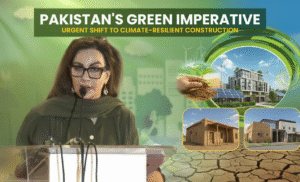

ISLAMABAD: Federal Minister for Climate Change Senator Musadik Malik issued a powerful warning on Wednesday highlighting the full scale of climate driven devastation confronting Pakistan. Speaking at the Pakistan Business Council during the opening of the fourth edition of its two day Dialogue on the Economy twenty twenty five he urged policymakers businesses and global partners to acknowledge the gravity of the crisis and act with urgency.
The conference also marked the twentieth anniversary of the Pakistan Business Council which has played a vital role in shaping national economic discourse. Organisers noted that Pakistan’s economy stands at a critical juncture where clarity long term reforms and strong institutional collaboration are crucial for stability and growth. Discussions centered on competitiveness investment climate aligned policymaking and the expanding responsibility of business in national development.
Addressing a session on climate and business resilience Senator Musadik Malik posed a stark question. What is more devastating war or climate. He said that the last four major floods in Pakistan claimed between four thousand six hundred and four thousand eight hundred lives a toll higher than many armed conflicts. More than eighteen thousand Pakistanis were injured or permanently disabled while nearly forty million citizens were displaced across those disasters.
The minister described the immense humanitarian toll noting that in the most recent flood nearly three million people were uprooted. Half of them were school going children resulting in an estimated one hundred and twenty million lost school days. He added that even without the human dimension the economic burden was catastrophic. The twenty twenty two floods alone inflicted losses equal to nine point eight percent of Pakistan’s GDP erasing years of development.
Senator Malik warned that Pakistan’s location beneath rapidly melting Himalayan glaciers placed it at extreme climate risk despite contributing less than one percent to global emissions. He criticised the imbalance in global climate finance noting that ten major emitters capture eighty five percent of available funds while vulnerable states struggle with rising losses and minimal support.
He also highlighted worsening smog disrupted crop cycles water insecurity and unpredictable rainfall patterns that threaten food supply for a population of two hundred and forty million. British High Commission Development Director Sam Waldock supported these concerns citing massive economic losses from displacement invisible asset damage and agricultural disruption. He urged businesses to integrate climate risk into their strategies as the Pakistan Business Council launched a Climate Risk Awareness Toolkit to help firms assess vulnerabilities.