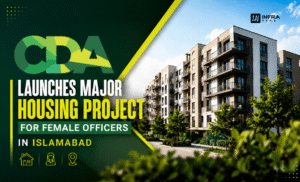

The Capital Development Authority has decided to complete the long delayed Nilore Heights housing project after the Naya Pakistan Housing and Development Authority effectively withdrew from its role. With full ownership now resting with the CDA, the civic body is preparing to revive construction and prevent further deterioration of the partially completed site in Islamabad.
Official sources say the CDA requires around Rs15 billion to complete the remaining work. Once finished, the project is expected to generate more than Rs50 billion in revenue, making it one of the most financially significant housing developments undertaken by the authority in recent years. The project was launched in 2021 and was originally scheduled for completion by 2023.
The development stalled last year when NPHDA failed to provide its agreed funding share. As a result, construction was halted after the grey structure of around 60 apartment blocks had been completed. Sources confirm that NPHDA has expressed willingness to formally exit the project, though final approval from the federal cabinet is still awaited.
The funding issue was discussed during a recent CDA board meeting chaired by Chairman Muhammad Ali Randhawa. The finance wing sought approval to obtain credit lines from commercial banks, but board members advised that a broader policy approval was required rather than project specific clearance. The summary has been deferred for reconsideration in the next meeting.
Alternative options including auctioning the project or pursuing a joint venture were also discussed. Board members stressed the urgency of completing the project to avoid further cost escalation and structural decay. Earlier this year, federal auditors highlighted that delays had already deprived the CDA of estimated benefits worth Rs14 billion.
In the same meeting, the board approved sites for model graveyards and directed the development of modern facilities and a dedicated online portal. Proposals for CDA owned fuel stations and incentives for facade improvement in Blue Area were also approved, reflecting a broader push for urban renewal alongside major housing completion efforts.